
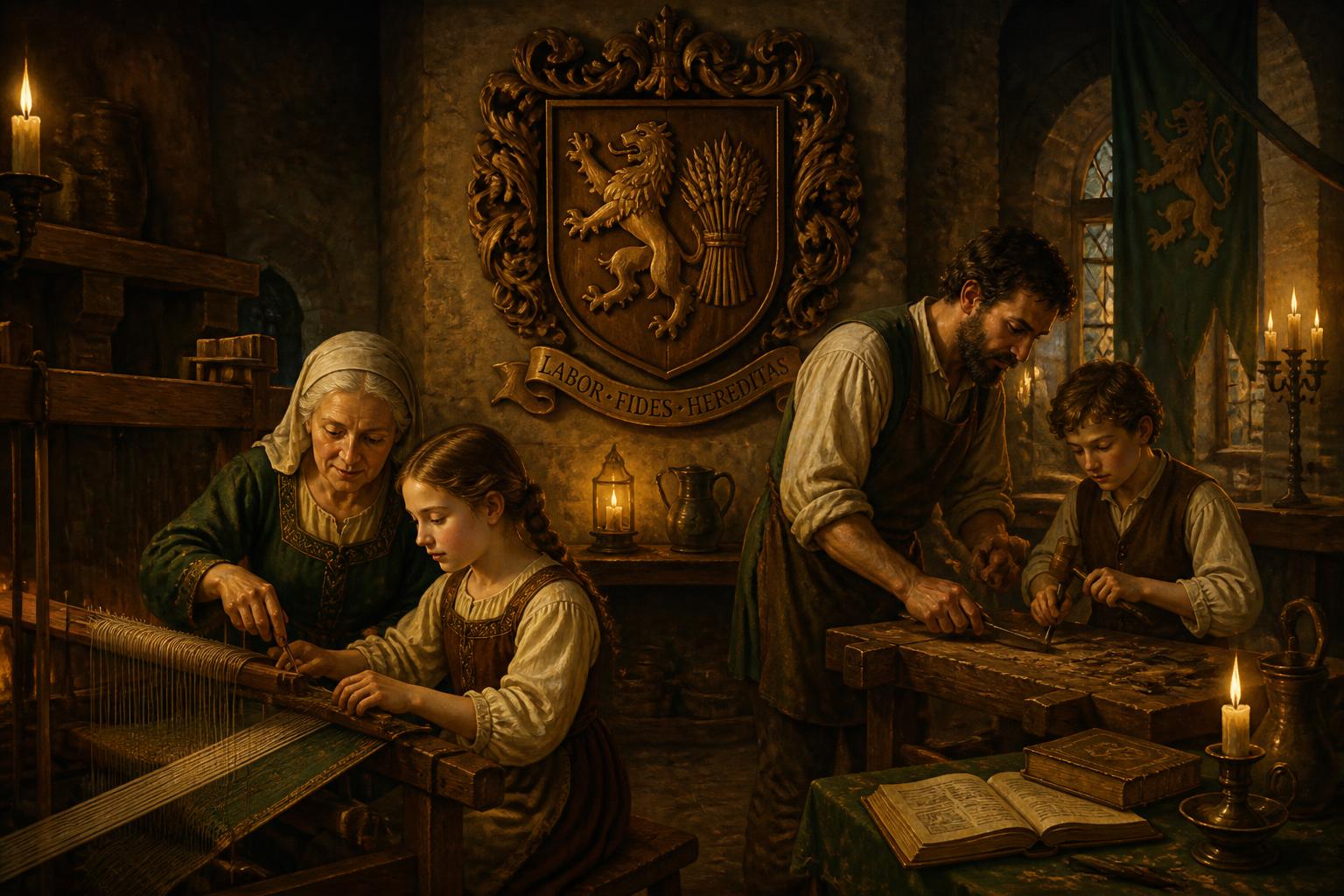
A family in a candlelit stone hall — a grandmother teaching a girl at the loom, a father and son at the workbench, a carved family shield above them

The GUILLD · the family shield

Every house gets a shield — and a guild of its own.

A business is never only a person. It is a house. Build the family shield, name the lines you came from, and the trade you carry gets a name over the door. This is the start of your genealogy — the first threads of your tapestry.

The concept

The shield told the market who you were before you spoke.

Before advertising, a house had arms. The colours said the character. The charge said the trade. The motto said the standard. A stranger read the shield and knew whether to bring you work. That is exactly what a Guild page does now — so we build it on purpose instead of leaving it to chance.

And a shield is inherited. It records that you did not begin from nothing: someone taught you, someone traded before you, someone kept the line. Naming those people is the first act of genealogy, and every name becomes a thread in the family tapestry.

Forge it now

Build your family shield.

Choose the field, the metal and the charge of your trade. Name the house and the motto. Then add the lines you came from — they carry into your tapestry.

House of ______

Provision — the house that feeds others

Your motto goes on the ribbon.

Field
Metal
Charge — the emblem of the trade

The lines — first threads of your tapestry

Name the people you came from and the place they came from. Each line you can name is a thread you can follow — the beginning of your genealogy, woven into the family tapestry.

Family models

What the mothers taught. What the fathers built. What the children carry.

What the mothers taught

Wisdom, and how to be wise.

The mother's room was the first school. She taught the reading of people, the timing of a word, the stretching of a resource, the keeping of a peace. Wisdom was not a lecture — it was demonstrated at the loom, at the table, at the bedside. Put her tips in writing: how she made a little go far, how she settled a quarrel, how she chose.

What the fathers built

Trade, standing, and protection.

The father carried the craft and the name. He apprenticed the sons and vouched for the household in the market. He taught the price, the contract, the boundary and the defence. Record his tips: how he priced work, how he kept his word, what he refused, how he trained a hand.

What the children carry

The line continued.

Children are not the audience of the house; they are the next chair in it. Each child takes a piece — the ledger, the loom, the land, the language — and carries it one generation further. On the shield, they are the lines beneath the charge.

How resources pool

One purse, many hands.

Families used to buy the tool once and share it. They stood the youngest up with the elders' credit. They put the whole house behind one shop until it stood, then behind the next. The Guild restores that model: pooled resource, shared standing, staged launches.

The same pattern, four places

Korea, China, England, Scandinavia — one family model.

The dramas keep showing us the same house: a recorded line, a woman governing the inner court, a man carrying the trade outward, elders placing the young, and resources pooled until the next shop stands.

Seen in the K-dramas

Korea · the Joseon house

The jokbo — the clan book — recorded every name in the line, and the hall kept the ancestors present at the table. The commoner rises by capability, the lord holds the sword and the plan, the king wears the robe and governs. The house was ranked, but the rank was earned by conduct and record.

Keep a book of names. Let conduct set the rank.

Seen in the Chinese dramas

China · the courtyard house

The zupu genealogy and the ancestral hall bound a whole clan into one economy. The matriarch ran the inner court — the discipline, the marriages, the money of the household. The elders' council placed a young man in a trade or a study. Merchant clans like the Huizhou houses funded a nephew's shop and shared the return across the family.

The inner court governs. The clan funds the venture.

The coat of arms

England · the guild household

The arms said who the house was in one glance: field, metal, charge and motto. The workshop stood in the front of the house and the family lived behind it. Apprentices ate with the family, and the widow often kept the freedom of the guild and ran the trade herself.

Put the trade on the shield. Live above the shop.

The longhouse

Scandinavia · the farm name

The farm itself carried the name, and the name travelled with the family. The húsfreyja held the keys — the stores, the cloth, the accounts — while the men sailed and traded. The saga was the genealogy: told out loud, generation by generation, so nobody forgot the line.

Give the woman the keys. Tell the saga out loud.

Put the shield on your Guild page.

Your house, your trade, your lines. When the family has a shield, the business has a lineage — and the next generation inherits standing, not a start from zero.

WomanCEOCollective

A members' network for women shaping the next generation of leadership, culture, and craft.

Explore

Connect

Newsletter

© 2026 WomanCEO Collective. All rights reserved.

Crafted with intention.

My pearls