The first law of the house
Your wish is your command.
Nothing here is granted to you. You command your walk and your way — the day, the work, the house, the ground you stand on. A wish left as a wish stays a wish. Spoken as a command, it becomes a plan, then a wall, then an estate.
A note in the margin
Commanding is an architect attribute — the CEO trait of a person, a partnership, or a business. The architect does not ask the ground for permission; she draws, she names, she orders, and the building follows the drawing. Command is not volume. It is a clear word given to a thing that has been designed.
Always kept, never posted for show
The Guild's Creed
- 01My wish is my command.Nothing here is granted. A wish spoken as a command becomes a plan, then a wall, then an estate.
- 02My trade is my weapon.I sharpen one craft until it can defend a household and feed a table.
- 03My work is kept by my works.I am judged by what I do in the situation, not by what I say or brand.
- 04I build a wall a day.Eight walls stand in the Octagon; I finish something on one of them before the day closes.
- 05I find the pea and I fix it.One hidden friction found, named and mended each day — and it pays a gain.
- 06I give a penny before I ask for a pound.I mint my token and hand it over first; the Guild is people helping people.
- 07I keep my own intelligence.I read, ponder and write my own answers. Borrowed thinking is not standing.

Est. 2008 · A men's collective
A lord to his castle — the castle he protects and provides for.
The castle is not himself. The castle is his wife, his sons and daughters, his table, his name and the land under all of it. He is the wall around it and the well inside it — the one answerable for whether it is defended and whether it is fed.
Which is exactly why there is a Guild. A man cannot protect what he cannot defend, and cannot provide what he has not learned to make. His trade is the weapon that does both — so the trade gets forged, drilled, vouched for, and handed down as inheritance.
The story of the Lord of the Castle
A lord inherits a hill, a ruin, and a name that is not yet worth anything. No one is coming to build it. The stone is on the ground where the last war left it.
So he begins where every real lord begins — not with the wall, but with himself. He is the first ground he must take. His temper, his hours, his appetite, his word. A man who cannot hold that ground will lose the castle with better walls than anyone.
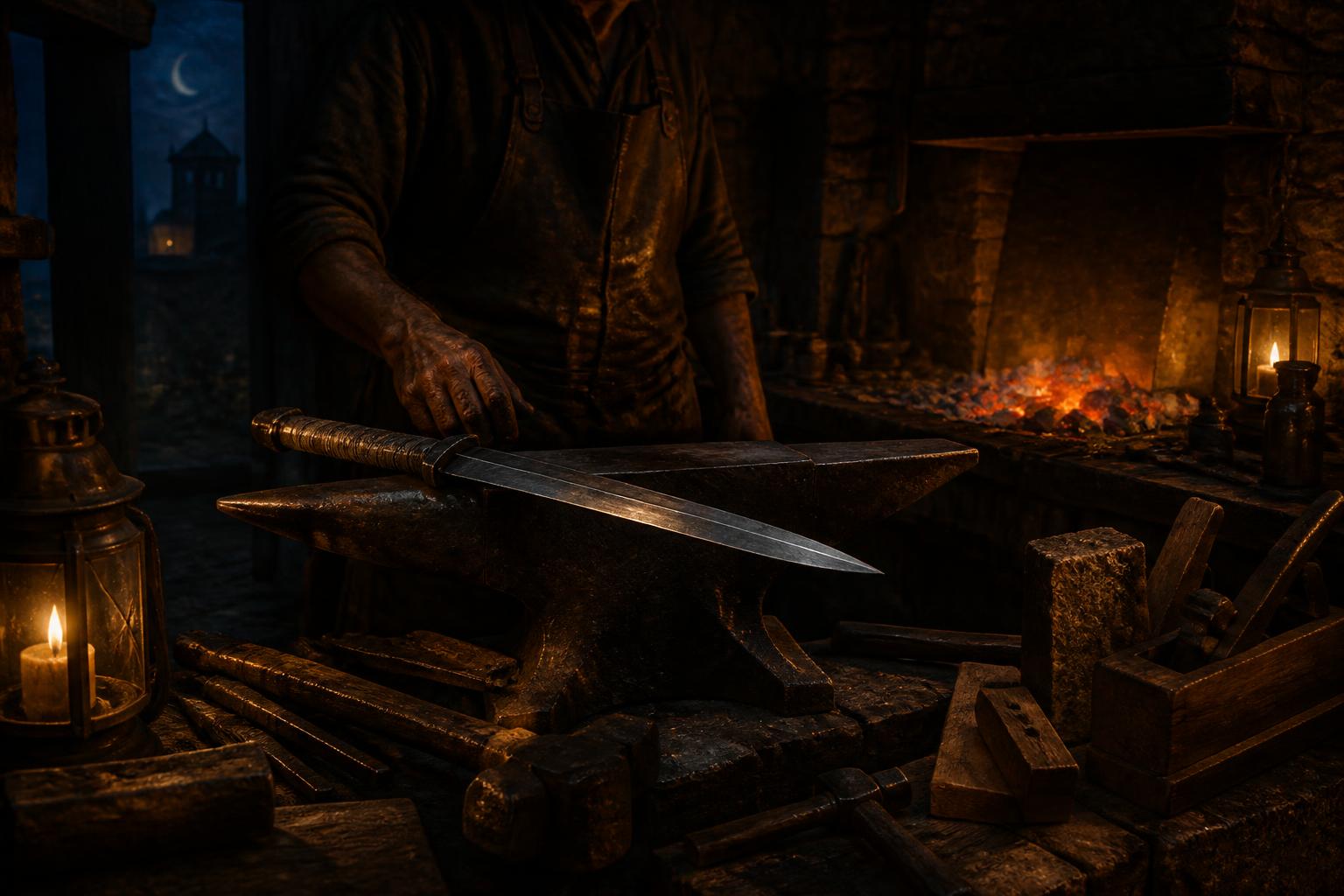
Then he takes up a trade, and learns the truth every guild has taught its apprentices for a thousand years: your trade is your weapon. Not a job. A weapon — which means it must be forged, drilled, sharpened, and rated honestly against other men who do it well. A man dangerous at his trade can feed a family, hire a brother, and refuse dishonest money without panic.
And then he does the thing that makes him a lord instead of a strong man: he builds for people who are not himself. A wife he covers. Children he cuts a road for. Sons and sons-in-law he hands a sharpened edge to. Brothers whose ladders he holds.
She strings pearls across a table. He sets stone on stone across generations. Same increase — different hands.
The E · The E · Character
Not that he is a lord — that he HOLDS the wall
The E is character in the working sense. Not his attribute, not his rank — his conduct. What he does with his hours, his money, his temper, his word, his unwitnessed choices. It is the verb of the day.
Being a man of strength is the C: the attribute he carries. Holding the office of prince, lord, father, foreman is the O: the title, the authority, the resources in his hands. Neither one defends anything by itself. The castle is held by what he actually does at the hour it is tested.
The lord who kept the watch
No one attacks the wall on the day the wall is inspected. They come on the ordinary night, at the hour a tired man would reasonably be asleep. Which means the castle was never held by the stone — it was held by whether he kept the watch when there was nothing to see.
His attribute made him able. His office gave him the charge. His character made him stand there anyway.
- In a man
- The drill he runs, the hour he keeps, the promise he pays for. Conduct, not conviction.
- In his business
- What the company does when the customer is wronged and no one is watching. Operations are character at scale.
- In a partnership
- Whether the terms hold when they become inconvenient, and how he handles being wrong in front of men.
- In a marriage
- Covered, provided for, listened to, defended. Not declared — done, on the hard days too.
The test · Ask: what does he DO on an ordinary Tuesday? That answer — not the rank, not the speech — is the character.
How a domain is taken
Three grounds of the lord.
01
He takes himself
The first territory is the man. Kept word, kept hours, kept fire. Everything after this is downstream of it.
02
He forges the weapon
His trade is drilled until it is dangerous. That is how a household is fed, and how a brother gets hired.
03
He builds past himself
A road cut, a standard kept, a name that opens gates he will never walk through. The house outlives him.
Rooms of the men's side
This is a portal, not a second project. The school, the Villiage, the planner and the revenue share are the same rooms — read from the man's side of the mirror.
The Thirty Laws, read for a man
Same laws, same order — a weapon, a post, a charge and an oath for every day.
Open →
The E — his character
Not that he is a lord. That he keeps the watch, runs the drill, and holds the wall.
Open →
The Men's Guild
His trade is his weapon. Sharpened, drilled, vouched for, and listed.
Open →
The Young Men's Guild
A separate gate for boys 14 to 19 — a weapon, four ranks, a ledger and his own guild card. At twenty he joins the men.
Open →
VisionCEO — the road
Pilgrim's Progress and the journeyman: eight burdens laid down, eight tools taken, and a blindfold to draw in the dark.
Open →
MissionCEO — The Alchemist
Santiago's desert: the flock sold, the trade learned, the omens read, the treasure buried where he began.
Open →
PlanCEO — the stone under the bed
The to-do wall. Lift the mattresses, find the one thing grinding under the day, name its size, and move it.
Open →
RichCEO — the ten scrolls
One scroll a day on the trade that is his weapon. Work joins the journey.
Open →
IQUI Akademy
The school is the same school — The School of His or Her Kingdom.
Open →
The Villiage
The same worldwide marketplace. His storefront stands beside hers.
Open →
Revenue share (4×7)
Men helping men fill a board — the same math, the same pennies that add up.
Open →
A Women's Collective
The other half of the mirror. Her strand of pearls, kept and protected.
Open →
The domain, in pictures
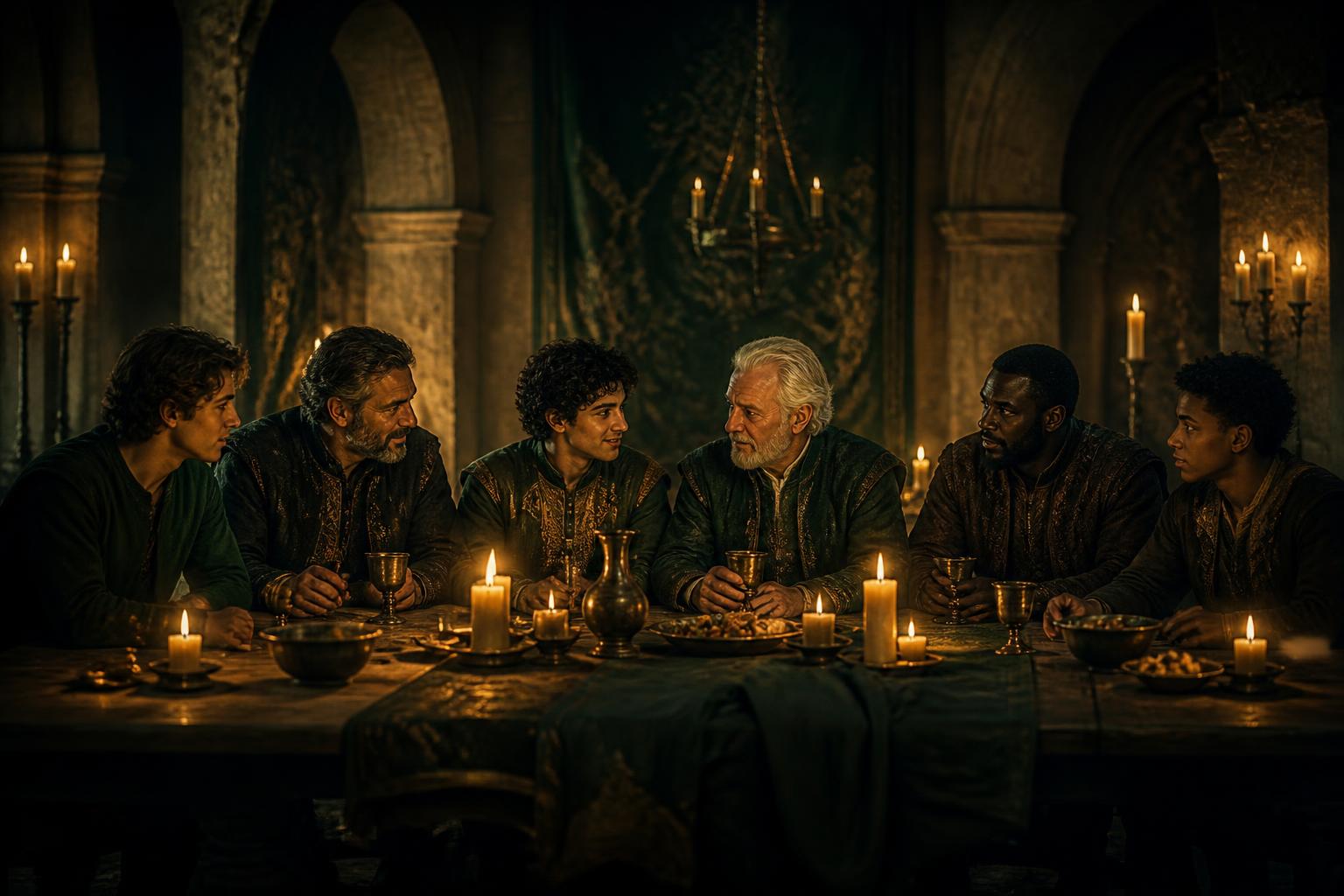
The keep, the forge, the table.